
Lessons from Our First Year Testing Battery-Powered Landscape Equipment
Let’s be honest: we thought the switch to battery-powered landscaping tools would be easier. At Seattle Sustainable Landscapes (SSL), we’ve spent the past year testing battery-powered blowers, trimmers, and mowers in real-world conditions. And while we wanted to love every minute of it, the reality? It’s been a mix of progress, headaches, lessons, and optimism.
If you’re curious about what it’s really like to move away from gas and toward battery equipment—here’s what we’ve learned (the good, the bad, and the battery-charging).
1. Performance Isn’t the Problem… Until It Is
Let’s start with the elephant in the yard: power. Battery-powered gear has come a long way, and most modern tools can hold their own—for light to moderate work. But when the leaves pile up or the grass is wet and heavy, the limitations become obvious. Gas equipment still wins when raw power is needed for extended tasks.
Our team especially felt this when using backpack blowers on large properties or trying to power through damp leaves on a chilly Seattle morning. That’s when the batteries started to… fizzle.
2. Battery Life Is Better Than It Was—but Still a Bottleneck
Depending on the brand and task, battery life varied from 30 to 60 minutes. For a homeowner, that’s plenty. For a professional crew on a full route? Not even close.
We quickly realized that the equipment itself was only half the challenge—the other half was battery rotation and recharging logistics. It’s like trying to manage a fleet of cordless drills on a construction site… without any power outlets.
This led us to another big takeaway…
3. The Problem Isn’t Just the Equipment—It’s the System
One of the biggest challenges wasn’t about runtime or performance—it was organization. We weren’t just testing new gear; we were learning how to:
- Keep batteries charged and rotated properly
- Equip trucks with mobile charging options
- Assign responsibility for battery inventory
- Make sure a crew didn’t accidentally take all the charged batteries to one job
It wasn’t the gear—it was the system that needed a serious overhaul.
4. Our Crews Had Opinions—Strong Ones
In 2024, we trialed battery-powered tools from Stihl and Milwaukee. Both are respected brands with solid reputations in electric tools, but… our crews weren’t impressed.
The main feedback:
- Not enough power for long workdays
- Batteries drained too fast under heavy use
- Ergonomics didn’t compare to gas equipment
- The tools felt like “homeowner gear dressed up as pro”
We’re not saying those manufacturers haven’t improved since—but at the time, those trials didn’t pass our field test.
5. We’re Getting Smarter with Every Season
Despite the challenges, we’ve made huge progress:
- Our crews are more familiar with battery gear
- We’ve improved our in-house charging systems
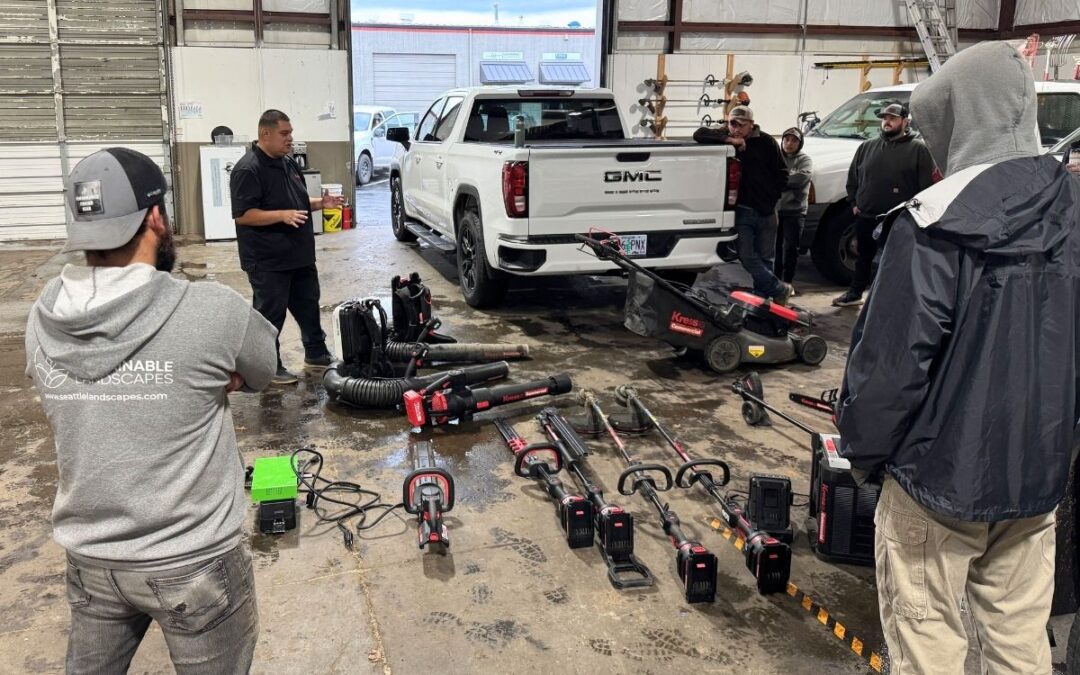
- We’re starting a new trial with Kress—a brand that’s getting solid reviews from other commercial landscaping firms (like K&D Landscaping in California)
We’re cautiously optimistic that Kress may be the breakthrough we need to go fully electric.
What We Got Right
- We involved our crews early and listened to their feedback
- We didn’t settle for battery equipment that wasn’t ready
- We treated this as a process, not an overnight switch
What We’re Still Working On
- Finding the sweet spot between battery capacity and tool performance
- Improving battery management systems
- Training and accountability for field crews
Final Thoughts
Switching to battery-powered tools isn’t plug-and-play. It’s an evolving journey that requires new thinking, new systems, and a lot of patience. But we’re sticking with it. Because the benefits—quiet, clean, sustainable service—are worth chasing.
Stay tuned for part two of this journey, where we share our findings from the Kress trial. We’ve got high hopes—and a lot of batteries to charge.
Let’s build the future of landscaping—one power pack at a time.